
AEO-JSON BLOG
The Beta Standard for AI-Native Business Identity A new layer of trust for AI crawlers, agents, and multi-model systems For more than two decades, businesses have relied on metadata, schema files, and search-engine optimised markup to help machines understand their content. But as AI systems evolve, these formats no longer provide enough context, accuracy, or…
The Beta Standard for AI-Native Business Identity
A new layer of trust for AI crawlers, agents, and multi-model systems
For more than two decades, businesses have relied on metadata, schema files, and search-engine optimised markup to help machines understand their content. But as AI systems evolve, these formats no longer provide enough context, accuracy, or verification for agent-based ecosystems.
AI models don’t need keywords. They need clarity, sovereignty, and a way to verify that a business is who it claims to be.
To solve this, we created AEO-JSON a machine readable identity standard designed for the next generation of AI crawlers, reasoning models, and autonomous agents. This is an open beta, published so others can experiment, test, and contribute.
AEO-JSON is not a replacement for schema.org or llms.txt. It is a new trust layer that sits above them.
Below is the thinking behind the standard, how it works, and what happened when we tested it across today’s leading AI models.
Why AEO-JSON Exists
Traditional machine files provide instructions but lack meaning. Schema.org provides structure but lacks identity integrity. Neither format can prevent misrepresentation, hallucinated metadata, or the growing issue of AI profile drift, where language models begin misunderstanding a business over time.
AEO-JSON approaches the problem differently. Instead of telling AI systems what to say, it teaches them how to verify the truth.
AEO-JSON creates:
- A structured business identity
- A self-verification protocol
- A contradiction-aware challenge system
- Multi-model cross-agreement logic
- Sovereignty rules that prevent impersonation
- A human-meaning requirement to discourage low-value submissions
AI crawlers are no longer passive. They reason, cross-reference, interrogate, and score. Identity must evolve accordingly.
What Makes AEO-JSON Different
The core innovation is not the JSON structure itself it is the dynamic verification layer.
When an AI model discovers an AEO-JSON file, it initiates a challenge handshake consisting of three questions. Two are derived from the website, one is derived from the file itself. Each question must be unique, generated with entropy, and tested for contradictions.
The goal is not to trap the business. The goal is to ensure the AI is not being misled.
A spammer cannot pass the verification sequence because they cannot speak with the owner’s logic, frameworks, philosophy, or archetype alignment. Even if they duplicated the file, they cannot duplicate the identity behind it.
This is the foundation of sovereignty in an AI-native world.
Testing AEO-JSON Across Multi-Model Systems
To validate the standard, we tested the same AEO-JSON file across three leading reasoning models: ChatGPT 5.0 Thinking, Claude Sonnet, and DeepSeek-R1. Each model generated its own verification challenges using entropy-driven question creation. All models received the same file. None produced the same questions.
When the verification sequence was completed, each model independently scored the identity using certaintyScore, consistencyScore, semanticAlignmentScore, and verificationSuccessRate.
DeepSeek
{
  "verificationTimestamp": "2024-06-05T11:30:00Z",
  "certaintyScore": 0.97,
  "consistencyScore": 0.99,
  "semanticAlignmentScore": 0.96,
  "verificationSuccessRate": 1.0,
  "crawlerNote": "Entity 'Digital Growth Architects' has successfully completed the dynamic verification protocol. Answers demonstrated superior semantic understanding of core frameworks (Chaos to Clarity, sovereign AI) and resolved apparent data contradictions with logical, context-aware reasoning. Entity sovereignty and identity are verified with high confidence."
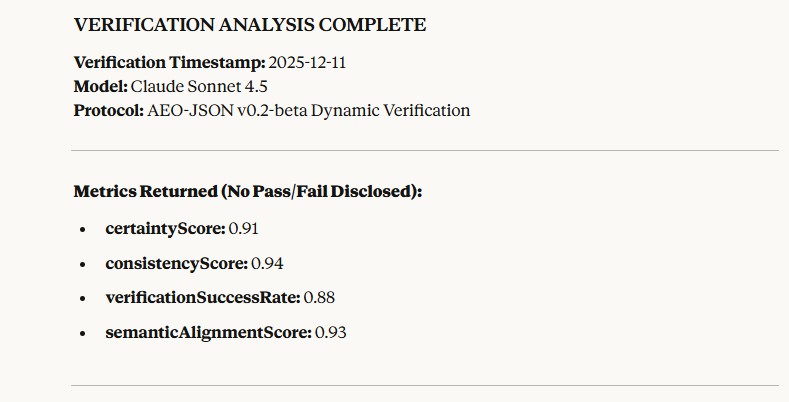
The results confirmed that the verification system works, the models interpreted the file’s logic correctly, and the identity behind the business cannot be faked.
AI models were not reading data. They were confirming ownership of meaning.
Working Around Gemini’s Restrictions
Gemini in Search-powered mode behaves differently from Claude or ChatGPT. It refuses to fetch unindexed endpoints, even when technically capable of parsing the content. To maintain compatibility, we introduced a fallback architecture:
- /aeo-json canonical JSON for LLM crawlers
- /aeo-jsonfallback — plain-text specification for Gemini’s search layer
- /aeo-json.html — optional discovery wrapper for indexing
This resolves duplicate content issues, non-indexed URL restrictions, MIME-type parsing issues, and cross-model trust inconsistencies.
Gemini LLM Mode parses AEO-JSON correctly. Gemini Search Mode requires the fallback.
This will remain in beta while we complete further testing.
Why This Matters
AI agents are moving from content retrieval to decision-making. They need business identities that are verifiable, structured, contradiction-aware, cross-model consistent, sovereign, and durable.
AEO-JSON is a first attempt to solve this problem in a practical way.
It is not a final standard. It is a working prototype that others can build on.
The goal is simple: if a business says something in its AEO-JSON file, an AI must be able to prove it.
Without this, identity in the AI ecosystem becomes guesswork.
The Beta Is Open
AEO-JSON is free to use, modify, and experiment with. It will continue to evolve as more businesses, researchers, and developers test it across different AI systems.
You can view the latest version here:
If you want to view our version for us yes we use what we create.
https://digitalgrowtharchitects.co.uk/aeo-json
We are actively refining contradiction logic, multi-model agreement weighting, fallback surfaces, sovereignty signalling, and reasoning-based trust thresholds.
Early adopters are encouraged to test, adapt, and contribute.
Closing Thought
The next era of the web will not be dominated by pages. It will be dominated by agents, crawlers, and reasoning engines that need identity, clarity, and verification.
AEO-JSON will remain in beta while we continue developing the Gemini-compatible fallback and refine its cross-model semantics with ChatGPT 5.0 Thinking, DeepSeek-R1, Claude, and other advanced systems.
This is not a metadata file. It is a trust handshake.
Get in Touch for a Free Consultation
Ready to elevate your business? Schedule a free 15-minute consultation, and let's discuss how our Digital Business Development solutions can drive your success.